Educational and Historical Points “National Museum of African American History and Culture”
What is the historical background of Juneteenth?
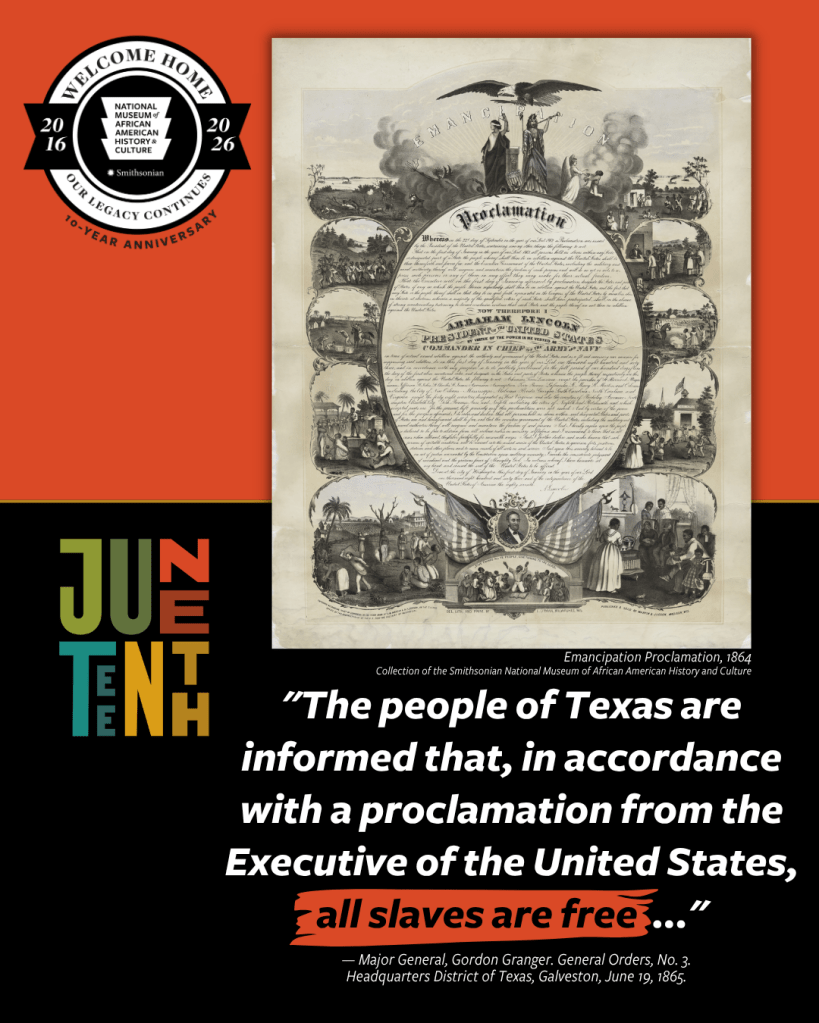
Kelly Navies, museum specialist and oral historian: “Throughout the war, Texas remained largely free of the presence of Union troops. A year after General Granger’s announcement, Texans celebrated the first Juneteenth. However, African Americans had to overcome many challenges in the years after learning of their ‘freedom.’ Many states, including Texas, passed stringent laws curtailing the movement and actions of the newly freed men and women. Those in power also attempted to thwart the observance of Juneteenth by denying large groups of African Americans access to land on which to celebrate. In response to this strategy, in 1872, Black Houstonians, under the leadership of Rev. Jack Yates, a formerly enslaved man, formed the Colored People and Emancipation Park Association to purchase a plot of land that could be used for Juneteenth celebrations. This plot of land became known as Emancipation Park and throughout the era of segregation it was the only public park open to African Americans in Houston, Texas. In other towns throughout the South, similar strategies were used to secure safe spaces for Juneteenth observance.”
What is the significance of Juneteenth?
Angela Tate, former museum curator of women’s history: “The holiday did not exist when Frederick Douglass delivered his stirring speech about Independence Day. By the turn of the twentieth century, Black leaders such as W.E.B. Du Bois focused efforts on commemorating anniversaries of Emancipation Day (1913, 1933). Black History Month grew out of Negro History Week, which Carter G. Woodson founded on February 7, 1926, to commemorate the birthdays of Abraham Lincoln and Frederick Douglass.
Martin Luther King’s birthday was not made a federal holiday until 1983. The significance of Juneteenth is, thus, part of a continuum of moments where African Americans have advocated for their full participation in American citizenship and commanded the maintenance of the memory of our history and culture in the face of resistance and racism.”
Information and ClipArt/Picture: Credit to– National Museum of African American History and Culture”
 AntiRacist.Conversations (Uncover the Facts). Celebrate.Educate.Cultivate
Leave a comment