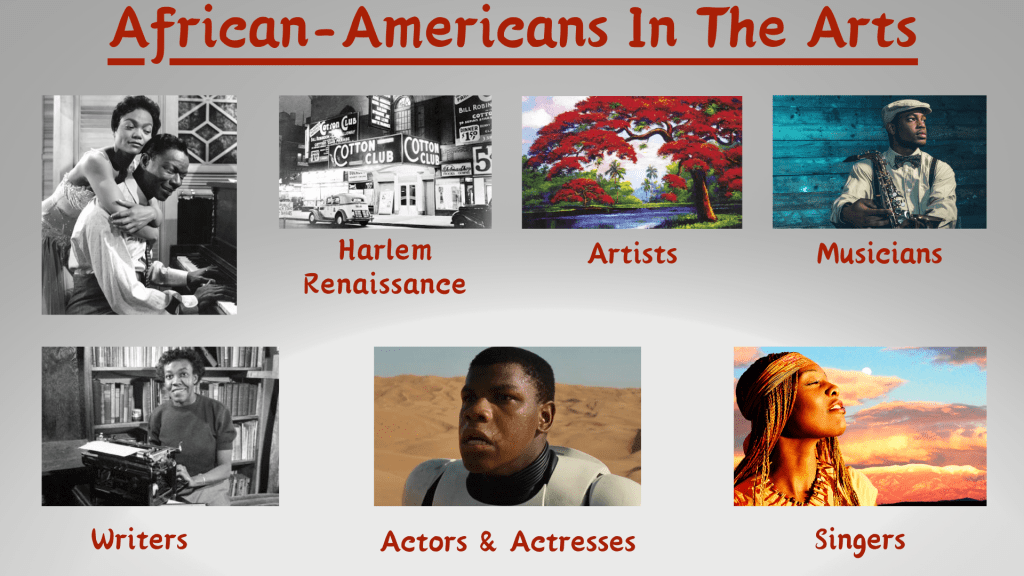
“The definition of an artist is wide-ranging and covers a broad spectrum of activities to do with creating art, practicing the arts, and/or demonstrating art. In deciding which African American artists we would highlight on our websites, we wanted to recognize persons, living or deceased, who have made significant contributions to the arts in America either as performing or practicing black artists in individual disciplines.
Think American arts and think African American: Ralph Ellison’s Invisible Man, Duke Ellington’s “Mood Indigo,” Jacob Lawrence’s “Migration of the Negro.” Artistic works by African Americans have revolutionized the American arts scene and given the cultural face, America shows the outside world its verve and vigor.
Being an artist requires talent, but, for African-American artists, talent is not always enough. In nineteenth-century America, race often determined who could be trained in the arts. There were no special schools or places where African Americans could freely exhibit their talents. These talented artists were excluded from the academies, associations, and teaching institutions available to white artists. In rare cases, beneficent white families broke the rules and provided knowledge, direction, and resources to budding African-American talents in the arts. Many of these white patrons were among the abolitionists of this period in American history.
In the early 1920’s there was a movement was called the “Negro” or “Harlem Renaissance”. This resurgence of literature, knowledge, and the arts coming out of New York was powerful. A fertile and acceptable door had been opened to African-American musicians, writers, poets, intellectuals, entrepreneurs, and visual artists. The opportunity was now available to grow and show off their best talents. From 1919 to about 1929, Harlem, New York became the capitol of cultural activity for African-Americans. This period in American history was extremely uplifting to African Americans as a people. Personalities and individuals connected their expressions in writings, music, and visual artworks as they related to the political, social, and economic conditions of being black in America.
One of the best speakeasies in Harlem was the Cotton Club, a place that intended to have the look and feel of a luxurious Southern plantation. To complete the theme, only African-American entertainers could perform there, while only white clientele (with few exceptions) were allowed to patronize the establishment. This attracted high-powered celebrity visitors such as Cole Porter, Bing Crosby, and Doris Duke to see the most talented black entertainers of the day. Some of the most famous jazz performers of the time – including singer Lena Horne, composer and musician Duke Ellington, and singer Cab Calloway – graced the Cotton Club stage.
Attending clubs in Harlem allowed whites from New York and its surrounding areas to indulge in two taboos simultaneously: to drink, as well as mingle with blacks. Jazz musicians often performed in these clubs, exposing white clientele to what was typically an African-American form of musical entertainment. As jazz hit the mainstream, many members of older generations began associating the raucous behavior of young people of the decade with jazz music. They started referring to the 20s, along with its new dance styles and racy fashions, as “The Jazz Age.”
By 1926, another stage in the developmental history of African-American visual artists came about. It was the establishment of the Harmon Foundation. The Harmon Foundation became an anchor for promoting the works of African-American artists. William E. Harmon, a real estate magnate, became the chief philanthropist and patron in the support of African-American artists and culture. Harmon’s interest in African-American artists reflected “his interest in promoting justice and social commitment.” The “deprivation of black Americans, he reasoned, was a national problem, not simply a burden on blacks alone.” The Harmon Foundation existed from 1922 to the end of 1967.
The 1940s and 1950s were not easy times for the African-American artists. Only the acceptable, critically acclaimed few were able to work and produce lucrative pieces of art. Patrons of the arts were still mostly white and wealthy. Artists like the Florida “Highwaymen” found a unique way to sell and display their art, by producing in mass quantities and selling their artwork on the side of the road. Thornton Dial’s art functions like folk tales, combining African and American traditions to tell stories that are at once personal, political, and spiritual. “
Harlem Renaissance
“In the early 1920’s there was a movement called the “Negro” or “Harlem Renaissance”. This resurgence of literature, knowledge, and the arts coming out of New York was powerful.
- Countee Cullen Gwendolyn Bennett W. E. B. Du Bois Jessie Fauset Langston Hughes Zora Neale Hurston James Weldon Johnson Claude McKay Wallace Henry Thurman Jean Toomer Dorothy West
Artists
Artists like the Florida “Highwaymen” found a unique way to sell and display their art, by producing in mass quantities and selling their artwork on the side of the road.
- Jean-Michel Basquiat ,Thornton Dial, The Florida Highwaymen, Jacob Lawrence ,Horace Pippin, Henry Ossawa Tanner. James van Der Zee
Musicians
African American musician Charlie Parker was one of the most widely influential soloists in jazz history and one of the creators of a new style of playing called bop, or bebop.
- Louis Armstrong, Count Basie, Benny Carter, John Coltrane, Miles Davis, Duke Ellington, Dizzy Gillespie, W.C. Handy, Jimi Hendrix, Quincy Jones, B.B. King, Jelly Roll Morton, Charlie Parker, Fats Waller
Writers
African-American writers have risen above racial inequality to examine life in both fiction and nonfiction arenas. They have provided intimate life details, presented new ideas, and created storylines that rise to the top of their field.
- Maya Angelou, James Baldwin, Imamu Amiri Baraka, Ed Bradley, Gwendolyn Brooks, William Wells Brown, Octavia Butler, Charles W. Chesnutt, Rita Dove Paul Laurence Dunbar, Ralph Ellison, Olaudah Equiano, Ernest Gaines, Nikki Giovanni, Alex Haley, Lorraine Hansberry, Robert Hayden, Bell Hooks, Robert C Maynard,Terry McMillian, Toni Morrison, Walter Mosley, Lucy Terry, Alice Walker, Phillis Wheatley, August Wilson, Harriet Wilson, Richard Wright
Actors & Actresses
When “Gone With the Wind” opened in 1939, Jim Crow laws prevented McDaniel from attending the film’s premiere. When she won her Oscar, she wasn’t even seated with the rest of her cast.
- Diahann Carroll, Don Cheadle, Dorothy Dandridge, Ruby Dee, Laurence Fishburne, Morgan Freeman, Gregory Hines, Samuel Jackson, Spike Lee, Hattie McDaniel,Tyler Perry, Ben Vereen, Sidney Poitier, Cicily Tyson, Denzel Washington, Oprah Winfrey
Singers
The earliest jazz and blues recordings were made in the 1920s. In the 1960s, soul performers had a major influence on the white US.
- Ella Fitzgerald, Aretha Franklin, Marvin Gaye, Marian Anderson, Harry Belafonte, Chuck Berry, Bobby “Blue” Bland, James Brown, Cab Calloway, Ray Charles, Nat King Cole, Sam Cooke, Lauryn Hill, Billie Holiday, Lena Horne ,Mahalia Jackson, Michael Jackson, Eartha Kitt, LL Cool J, Prince, Bessie Smith”
(Credit: myblackhistory.net BHA-Black History America)
 AntiRacist.Conversations (Uncover the Facts). Celebrate.Educate.Cultivate
Leave a comment